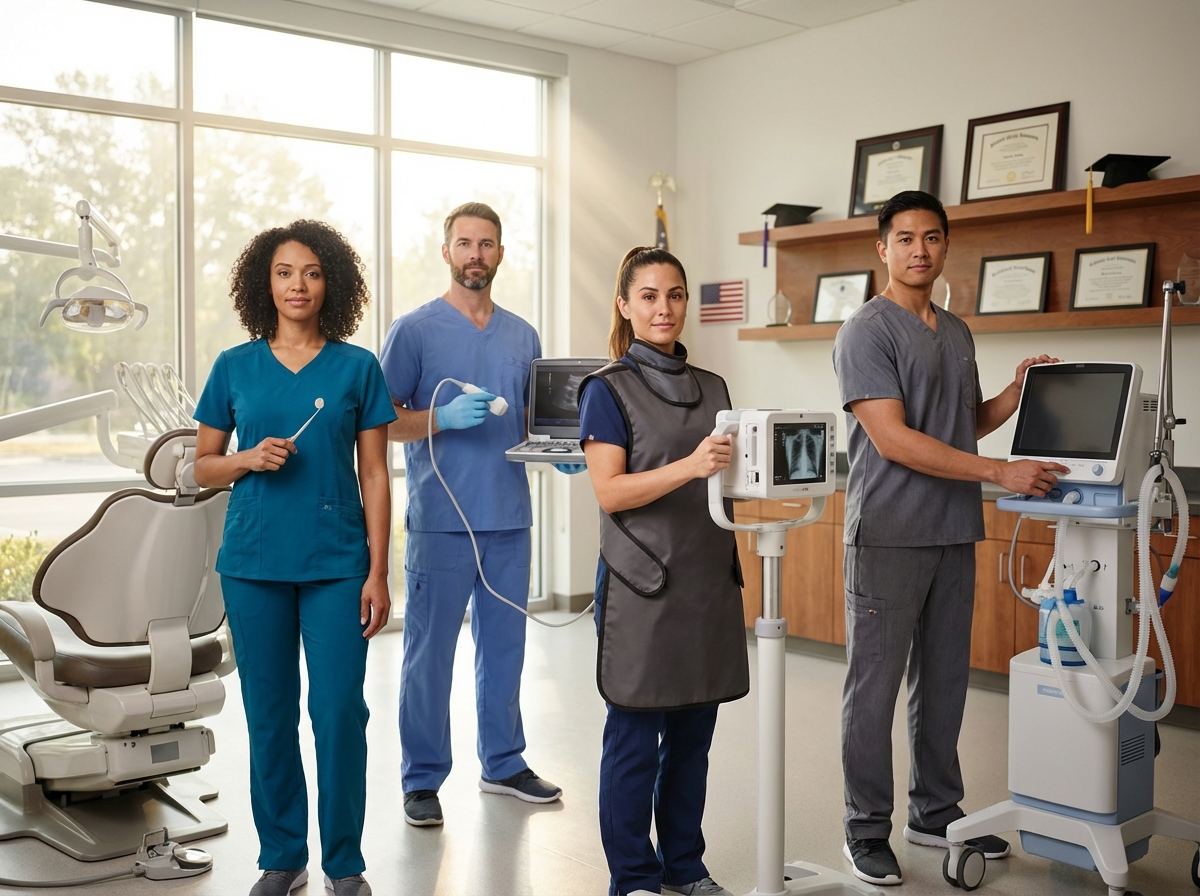
Discover the highest-paying allied health careers you can enter with a 2-year associate degree. This article compares top programs across the U.S.—radiography, sonography, dental hygiene, respiratory therapy, nuclear medicine, PTA/OTA—by salary ranges, accreditation, program length, costs, admissions, and employment outcomes. Use these insights to compare schools and pick the fastest, most lucrative pathway into allied healthcare.
Why an Allied Health Associate Degree Is a Smart Career Move
Choosing a career in healthcare often feels like a choice between a decade of school or a low-paying entry-level job. This is not the case in the allied health sector. Allied health occupations represent a massive category of healthcare roles that do not include doctors or nurses. These professionals provide diagnostic, technical, and therapeutic services that are essential for patient care. They are the people who take your X-rays, manage your respiratory therapy, and handle the complex imaging equipment in hospitals. For many of these roles, a two-year associate degree is the standard entry point. This path is one of the most efficient ways to secure a stable and well-paid position in the current economy.
The time-to-employment is a primary advantage of the associate degree route. Most allied health programs at community colleges or technical schools take between 20 and 24 months to complete. When you compare this to a traditional four-year bachelor’s degree, the benefits are obvious. You enter the professional workforce two years earlier. This allows you to start earning a real salary while others are still sitting in classrooms. You also avoid the extra two years of tuition and the associated living expenses. For career changers or those looking to start working quickly, this efficiency is hard to beat. You can find more details on these paths in this list of 11 Types of Healthcare Degrees You Can Earn in 2 Years or Less.
The return on investment for these programs is often exceptional. Tuition for an allied health associate degree at a public community college typically ranges from $4,000 to $12,000 for in-state residents. Even at private technical schools, the costs are manageable when compared to the expected starting wages. The opportunity cost of staying in school for four years is high. By choosing a two-year path, you gain two years of income that can range from $60,000 to over $90,000 depending on the specialty.
A clear example of this ROI can be seen in the dental hygiene field. A typical program might cost a student $10,000 in total tuition and fees. According to the Bureau of Labor Statistics (BLS) May 2023 data, the median annual wage for a dental hygienist is $87,530. In this scenario, the student earns back the entire cost of their education in less than two months of full-time work. This is a level of financial efficiency that few other industries can offer. Physical Therapist Assistants see similar benefits. With a median salary of $64,080 and a program length of about 20 months, the payback period remains very short.
Workforce demand is another factor that makes this a smart move. The United States is facing a significant demographic shift. The population of people aged 65 and older is projected to reach approximately 84 million by 2050. This aging group requires more medical imaging, more physical therapy, and more respiratory support. At the same time, hospital staffing models are shifting. There is a growing emphasis on outpatient care centers and specialized clinics. These facilities rely heavily on allied health professionals to maintain high patient volumes. The Bureau of Labor Statistics projects growth rates as high as 26 percent for some of these roles through 2032.
Geographic location plays a major role in how much you can earn. While the national median for many of these jobs is high, certain states pay significantly more. For instance, a dental hygienist in California can earn a median of over $120,000. Radiologic technologists in outpatient care centers often see higher pay than those in general hospitals. It is important to look at state licensure maps and local demand when picking a specialty. Most of these high-paying roles require a license from a state board or a national credentialing body. You can see how these salaries stack up in the Top 10 Highest-Paying Allied Health Specialties for 2025.
For those entering the workforce for the first time or switching from a different industry, these degrees offer a clear structure. The programs are usually accredited by specific bodies like the Commission on Accreditation of Allied Health Education Programs. This ensures that the training meets industry standards. Most programs include a heavy focus on clinical hours. This hands-on experience makes graduates immediately employable. By the time you finish your degree, you have already spent hundreds of hours working in a real medical setting. This practical focus is why the transition from student to professional is so fast in this field.
Top Highest-Paying Allied Health Careers Accessible With an Associate Degree
Radiation therapists earn the highest median salary among associate degree holders at $98,300. These specialists work in hospitals and oncology clinics to deliver prescribed radiation doses to cancer patients. Programs typically last 24 months and require roughly 2,000 clinical hours for completion. The Joint Review Committee on Education in Radiologic Technology (JRCERT) provides accreditation. You must pass the American Registry of Radiologic Technologists (ARRT) exam. All 50 states require licensure for this role. Graduates can realistically start working within two months of finishing their program. Salary increases often come from specializing in medical dosimetry or moving into management.
Nuclear medicine technologists bring in a median annual wage of $92,500. They use radioactive materials to image organs or treat diseases. Most work in hospitals and specialized imaging centers. The Joint Review Committee on Educational Programs in Nuclear Medicine Technology (JRCNMT) is the accrediting body. You will need to pass exams from the Nuclear Medicine Technology Certification Board (NMTCB) or the ARRT. About 40 states require a specific license to practice. The path to employment takes about 24 months of schooling. Graduates often find jobs within 90 days of certification.
Dental hygienists earn a median of $87,530. This role is one of the most popular allied health paths. Outpatient dental offices are the main employers. The Commission on Dental Accreditation (CODA) oversees these programs. You must complete at least 1,500 clinical hours. Licensure is mandatory in 49 states. California offers the highest pay with a median exceeding $120,000. Most graduates earn their credentials and start working within three months of graduation.
Diagnostic medical sonographers earn a median salary of $84,470. The top 10 percent of earners make more than $116,000. They work in hospitals and diagnostic labs. The Commission on Accreditation of Allied Health Education Programs (CAAHEP) accredits these programs. You should seek certification through the American Registry for Diagnostic Medical Sonography (ARDMS). Only 20 states require a license. Most employers prefer candidates with specialized registries in abdomen or obstetrics. Travel assignments are very lucrative for sonographers. Some contracts offer $3,000 per week.
MRI technologists earn a median of $83,740 per year, though average hourly rates can reach $44 in high-demand settings. They operate scanners that use magnetic fields to create images. Programs usually take 24 months to complete. The ARRT is the primary credentialing body. Licensure rules vary by state. Many technologists start as radiologic technologists and cross train into MRI. This move can increase pay by $10,000 annually. Travel MRI roles are currently paying around $3,538 per week.
Respiratory therapists earn a median of $77,960. They treat patients with breathing disorders in hospitals and care facilities. The Commission on Accreditation for Respiratory Care (CoARC) accredits these two year programs. You must earn credentials from the National Board for Respiratory Care (NBRC). 48 states require licensure. Demand is high with a 13 percent growth rate. Night shifts and holiday pay are major salary drivers. Some therapists earn 30 percent more than their base pay through overtime.
Radiologic technologists earn a median of $73,410. They perform diagnostic imaging like X-rays. JRCERT accredits these programs. You must pass the ARRT exam. 38 states require a license. Growth is steady at 6 percent. Graduates can start working almost immediately after passing the registry exam. Many use this role as a stepping stone to higher paying specialties like CT or Interventional Radiology.
Physical therapist assistants (PTA) and occupational therapy assistants (OTA) focus on patient rehabilitation. PTAs earn a median of $64,080. OTAs earn a median of $67,010. PTAs have a 19 percent growth rate. OTAs have a 23 percent growth rate. PTAs are accredited by CAPTE. OTAs are accredited by ACOTE. Both roles require passing national exams and obtaining state licenses. Most programs take 20 months to complete. Graduates often have multiple job offers before they even finish school.
Comparison of High Paying Allied Health Careers
| Job Title | Median Salary (BLS) | Projected Growth | Primary Registry |
|---|---|---|---|
| Radiation Therapist | $98,300 | 2% | ARRT |
| Nuclear Medicine Tech | $92,500 | 2% | NMTCB/ARRT |
| Dental Hygienist | $87,530 | 7% | CODA |
| Sonographer | $84,470 | 10% | ARDMS |
| MRI Technologist | $83,740 | 4% | ARRT |
| Respiratory Therapist | $77,960 | 13% | NBRC |
| Radiologic Tech | $73,410 | 6% | ARRT |
| OT Assistant | $67,010 | 23% | NBCOT |
| PT Assistant | $64,080 | 19% | NPTA |
Cardiovascular technologists and technicians work in cardiac catheterization labs. They assist with procedures like stenting and angioplasty. The median pay is roughly $66,170 but can reach much higher in specialized hospital units. Growth is projected at 4 percent. The primary credentialing body is Cardiovascular Credentialing International (CCI). Most programs are 24 months long. Graduates can find work in about three months after passing their registry exam.
Picking the right path depends on your local market. For example, 15 High-Paying Allied Health Careers in 2025 – Prolink highlights how respiratory therapy remains a top choice for hospital settings. If you prefer outpatient work, dental hygiene or sonography might be better. Always check the Top 10 Highest-Paying Allied Health Specialties for 2025 to see which roles are trending for travel assignments. Travel roles often double the median salary for those willing to move every few months.
How to Compare Allied Health Schools Programs and Outcomes
Selecting a program for an allied health career requires more than just looking at the tuition price or the commute. Since you want to enter the workforce in 24 months with a high-paying role, the program quality determines your starting salary and your ability to get licensed. A school might offer a low-cost associate degree, but if its graduates cannot pass the national certification exams, the degree is useless. You need a systematic way to filter through community colleges and private technical schools to find the best return on investment.
The Non-Negotiable Role of Accreditation
Accreditation is the first filter for any program. If a program lacks programmatic accreditation, you might be ineligible to sit for national board exams. This is different from institutional accreditation, which just means the school can accept federal financial aid. You must look for specific bodies based on your chosen field. For radiologic technology, the Joint Review Committee on Education in Radiologic Technology (JRCERT) is the gold standard. Diagnostic medical sonography programs should be accredited by the Commission on Accreditation of Allied Health Education Programs (CAAHEP). Respiratory therapy requires the Commission on Accreditation for Respiratory Care (CoARC). Dental hygiene programs must have the stamp of the Commission on Dental Accreditation (CODA). Physical therapist assistant programs need the Commission on Accreditation in Physical Therapy Education (CAPTE), while occupational therapy assistant programs require the Accreditation Council for Occupational Therapy Education (ACOTE). Without these specific credentials, your path to a license is blocked in most states.
Evaluating Program Effectiveness Data
Every reputable allied health program publishes a Program Effectiveness Data report. You should request this document if it is not clearly visible on the school website. Look for a graduation rate of at least 80 percent. A low graduation rate often signals poor student support or overly difficult clinical requirements that the school fails to manage. The most critical metric is the first-time pass rate on national certification exams, such as the ARRT for radiology or the NBRC for respiratory therapy. Aim for programs with a pass rate above 90 percent over the last five years. You should also ask for the job placement rate within six to twelve months of graduation. High-performing programs often see 95 percent of their graduates employed quickly. Finally, ask for the average starting salary of recent grads. This helps you verify if the local market matches the national median salaries reported by the Bureau of Labor Statistics.
Clinical Placement and Facility Quality
The quality of your clinical rotations defines your skill level. Ask the program director for a list of hospital and employer affiliations. Programs partnered with major systems like the Mayo Clinic or Kaiser Permanente offer better networking opportunities. You want to know if you will rotate through different settings, such as Level I trauma centers, outpatient clinics, and specialized labs. This variety makes you more marketable. Inquire about the equipment on campus as well. If you are studying to be an MRI technologist or a sonographer, the machines in the school lab should be current models. Learning on 20-year-old technology will leave you unprepared for modern hospital environments.
Faculty Experience and Cohort Dynamics
The instructors should have at least three to five years of recent clinical experience. Healthcare changes fast, and you need teachers who understand current protocols. Cohort size also matters. Allied health skills are hands-on, so a small cohort of 20 to 30 students ensures you get enough time with the equipment and the instructors. If a program packs 60 students into a lab with only two ultrasound machines, your practical skills will suffer.
Schedule Flexibility and Future Growth
Most allied health associate degrees are full-time because of the heavy clinical hour requirements. JRCERT-accredited radiography programs often require over 2,000 clinical hours. This makes it difficult to work a full-time job simultaneously. Some schools offer evening or weekend cohorts, but these are rare. Be wary of 100 percent online programs for clinical roles. While some didactic coursework can be hybrid, you cannot learn patient care or machine operation through a screen. Additionally, check for articulation agreements. These are formal contracts between the community college and four-year universities that allow your associate credits to transfer toward a Bachelor of Science. This is vital if you eventually want to move into management or specialized roles like a Pediatric Echocardiographer.
Comparison Metrics Spreadsheet
To make an informed choice, build a spreadsheet to compare your top three choices side-by-side. Use the following columns to organize your research.
| Comparison Factor | Program A | Program B | Program C |
|---|---|---|---|
| Programmatic Accreditor | (e.g., CAAHEP) | ||
| Total Program Cost | (Tuition + Fees) | ||
| Graduation Rate | (%) | ||
| First-Time Board Pass Rate | (%) | ||
| Job Placement Rate (6 Mo) | (%) | ||
| Clinical Hours Provided | (Total Number) | ||
| Primary Clinical Sites | (Hospital Names) | ||
| Avg. Starting Salary | ($ Amount) |
Verifying School Claims
Do not take the admissions office’s word at face value. Verify their claims by visiting the websites of the accrediting bodies. Most accreditors, like JRCERT or CAAHEP, maintain directories of accredited programs along with their reported pass rates. You can also check state board of health statistics for licensure data. For a deeper look, review registrant data from the ARRT, ARDMS, or NBRC to see how many graduates from that specific school are actually active in the field. If possible, contact the clinical coordinators at local hospitals and ask which school produces the most prepared graduates. They are the ones hiring, and their feedback is the most honest assessment you can get. This due diligence ensures you pick the fastest, most reliable path to 15 high-paying allied health careers available today.
Admissions Requirements Prerequisites and How to Accelerate Entry
Getting into a top-tier allied health program requires more than just a high school diploma. Most selective schools look for a solid foundation in science and math before you even apply for the clinical portion of the degree. You will likely need to complete Anatomy and Physiology I and II, Microbiology, College Algebra, and English Composition. These are not just check-boxes. Most programs expect a minimum GPA of 3.0, but the reality is that many accepted students carry a 3.5 or higher. If you want to be a physical therapist assistant, your grades in these core sciences will be the first thing admissions officers check.
Entrance Exams and Screening Tools
Entrance exams are another major hurdle. About 70 percent of community colleges use the TEAS exam to screen applicants. Others might require the HESI or a program-specific assessment. You generally need at least a 60 percent score to be considered, but higher scores are always better. Beyond academics, you must be ready for the clinical environment. This means passing a criminal background check and a drug screen. You will also need up-to-date immunizations for Hepatitis B and Tuberculosis, along with a current CPR BLS certification. These requirements ensure you are safe to work with patients from day one of your rotations.
Competitive Selection Strategies
To stand out in a crowded pool of applicants, you need more than just good grades. Many programs, especially dental hygiene, require between 40 and 100 observation hours. Seeing the work firsthand proves you know what the job entails. Volunteering in a pre-health capacity or working as a medical assistant can also give you an edge. Timing your application is just as important. Many schools use rolling admissions or have multiple cohort starts throughout the year. Applying early for a fall cohort or targeting a less popular spring start can increase your chances of getting a spot. If you are looking at allied health specialties, check which ones have the most frequent start dates in your area.
Legitimate Accelerated Options
If your goal is to enter the workforce as fast as possible, look for accelerated options. Some schools offer summer starts or year-round cohorts that eliminate long breaks. This allows you to finish a 24-month program in about 18 to 20 months. Some hospitals partner with local colleges to create fast-track hiring pipelines. These partnerships often mean your clinical rotations happen at the same facility where you will eventually work. This can significantly shorten the job search after graduation. Some programs even offer condensed clinical rotations where you spend more hours per week on-site to finish the requirements sooner.
Risks and Trade-offs of Acceleration
Acceleration comes with risks. When you compress clinical hours and coursework, you have much less downtime for studying. The pace is intense and can lead to burnout if you are also trying to work a part-time job. You might find that clinical hour compression leaves you with less time to absorb complex procedures. It is a trade-off between getting a paycheck sooner and having a more manageable schedule. You should evaluate if you can handle a 40 to 50 hour weekly commitment between classes and clinicals before choosing the fastest path.
Realistic 18 to 24 Month Timeline
A successful path to employment follows a strict schedule. Use this checklist to stay on track.
- Months 1 to 6
Complete all core prerequisites like Anatomy and Physiology. Aim for A grades to keep your GPA above 3.5. Schedule and take the TEAS or HESI exam early so you have time for a retake if needed. - Months 7 to 9
Gather your observation hours and letters of recommendation. Complete your background check and get your immunizations in order. Research the high-paying allied health careers to ensure you are choosing a path with strong local demand. Submit applications to at least three accredited programs to increase your odds. - Months 10 to 24
Enter the clinical program. Focus on building relationships during your rotations. If you are in an accelerated track, treat the program like a full-time job to stay on top of the workload. Begin your certification exam prep at least three months before graduation.
Following this timeline allows you to transition from student to professional without unnecessary delays. By optimizing your prerequisite grades and choosing a program with year-round starts, you can reach the high-paying tiers of the allied health workforce in less than two years.
Financing Your Program and Maximizing Earnings After Graduation
Paying for a two year degree in allied health is often more manageable than many people realize. Most students start the process by completing the FAFSA to determine eligibility for the federal Pell Grant. For the 2024-2025 academic cycle, this grant provides up to $7,395 per year. This is essentially free money that does not require repayment. Many states offer additional grants specifically for residents entering high demand healthcare fields. You should also look into institutional scholarships from the college itself. Private awards from healthcare foundations or local hospital systems can further lower your total bill.
Federal student loans are a common tool if grants do not cover everything. Subsidized Stafford loans are the best choice because the government pays the interest while you are in school. Some programs now offer income share agreements. In these arrangements, you pay nothing upfront. You then give a percentage of your salary back to the school after you secure a job. Additionally, graduates who work for non-profit hospitals or government agencies may eventually qualify for Public Service Loan Forgiveness (PSLF), which can eliminate remaining federal debt after 120 qualifying payments.
Employer and Military Support
Tuition Reimbursement
Hospitals frequently help their employees with education costs. Many facilities offer reimbursement around $5,250 per year. If you work as a transporter or a medical assistant while studying, your employer might pay for your associate degree. This is a common path for those already working in healthcare systems.
Military and Veterans Benefits
Veterans can use the GI Bill to cover 100 percent of costs at many accredited programs. This benefit often includes a monthly housing allowance. Veterans also receive hiring preference at many major hospital systems. This makes the transition from service to a civilian healthcare career much smoother.
Reducing Net Costs and Managing Funds
Choosing a community college is the most effective way to save money. Total tuition for an associate degree at a public school usually ranges from $4,000 to $12,000. This is significantly lower than private vocational schools. You should also check for credit for prior learning. If you have military medical training or previous college credits, you might be able to skip certain classes. This can shorten a physical therapist assistant program by three to six months. Building an emergency fund is vital during this time. Try to save at least three months of living expenses before starting clinical rotations. Clinicals are full time and leave very little room for side jobs.
Maximizing Earnings After Graduation
Your base salary is just the starting point in allied health. Shift differentials are the easiest way to earn more immediately. Working evenings often adds $5 per hour to your rate. Night shifts can add $7 per hour. For a respiratory therapist, this can increase annual pay by over $14,000. Weekend shifts also come with premium pay in most hospital settings.
Specialty Credentials and Cross Training
Earning high value certifications is a proven strategy for higher pay. Cross training in a second modality makes you much more valuable to employers. A radiologic technologist who earns a CT certification can see a $10,000 annual raise. Diagnostic medical sonographers who specialize in pediatric echocardiography often reach the top of the pay scale. You can find more details on these roles in this list of the Top 10 Highest-Paying Allied Health Specialties for 2025.
Travel and Per Diem Work
Travel contracts offer the highest short term pay in the industry. MRI technologists on travel assignments can earn $3,538 per week. This figure includes housing stipends and travel reimbursements. Sonographers can find contracts paying $3,000 per week. Per diem work is another option. This involves picking up extra shifts at different facilities for a higher hourly rate without benefits. It is a great way to boost income quickly. You can explore more about these high paying paths through Best Paying Nursing and Healthcare Jobs for 2025 – ENGAGE.
Long Term Career Mapping
Do not accept the first salary offer without checking local data. Use outcomes from your program to prove your value during negotiations. If your cohort had a 95 percent pass rate on national exams, mention that. Long term growth involves moving into supervisory roles or clinical specialist positions. These roles often involve working for equipment manufacturers in sales or education. While some of these positions eventually require a bachelor degree, your experience with an associate degree is the foundation. Many community colleges have articulation agreements that make finishing a bachelor degree much faster and cheaper later on. This path leads to roles with significantly higher management salaries.
| Allied Health Role | Median Base Salary | Potential with Travel or Specialty |
|---|---|---|
| MRI Technologist | $83,740 | $180,000 (Travel Contracts) |
| Dental Hygienist | $87,530 | $122,500 (High-Pay States like CA) |
| Respiratory Therapist | $77,960 | $95,000 (Night Shift Differential) |
| Radiologic Technologist | $73,410 | $88,000 (With CT Certification) |
Final Results and Next Steps for Choosing a Program
Choosing the right path in allied health requires looking past the initial salary figures. You need to focus on the long term return on investment. The fastest route to a high paying career is often a two year associate degree from a community college or a specialized technical school. These programs usually cost between 4,000 and 12,000 dollars for in state residents. When you compare that to a starting salary of $87,530 for a dental hygienist, the math is simple. You can pay off your education in less than a year of work.
The first thing you must verify is accreditation. If a program is not accredited by the proper body, you might not be able to sit for your national certification exams. For radiologic technology, look for JRCERT. For sonography, look for CAAHEP. For respiratory therapy, ensure the program is recognized by CoARC. Without these credentials, your degree might not lead to a license. Most states require a license to practice, and they almost always require proof that you graduated from an accredited school and passed a national registry exam. Some states may also require jurisprudence exams or specific background checks, so verify requirements with your local board.
You should also look closely at the program outcomes. Schools are usually required to publish their first time pass rates for certification exams and their job placement rates. A high quality program should have a pass rate above 85 percent. If a school has a low pass rate, it suggests the curriculum might not be preparing students for the actual demands of the job. Job placement rates should be above 90 percent within six months of graduation. In this 2025 market, healthcare facilities are desperate for staff, so a lower placement rate is a major red flag.
Clinical partnerships are another critical factor. You will need between 1,000 and 2,000 hours of hands on clinical experience depending on your specialty. Programs with strong ties to major hospital systems like Kaiser Permanente or the Mayo Clinic often provide better training. These clinical rotations are essentially long job interviews. Many students receive job offers from their clinical sites before they even graduate. If a program asks you to find your own clinical placements, you should probably look elsewhere.
Before you enroll, you must confirm the specific licensure rules in your state. Some states have much higher pay but more hurdles. For example, a dental hygienist in California can earn a median of 122,500 dollars, but the state has its own specific board requirements. Other states might only require the national certification. You can find more details on these roles in the 15 High-Paying Allied Health Careers in 2025 guide.
Five Step Checklist for Choosing Your Program
1. Shortlist three accredited programs in your region or preferred work area. Focus on community colleges for the lowest tuition costs.
2. Request official outcome data from each school. Specifically ask for the five year average for first time certification pass rates and the most recent job placement statistics.
3. Confirm the list of clinical placement partners. Ensure the sites are reputable hospitals or busy outpatient centers where you can get diverse experience.
4. Calculate the total net cost including tuition, fees, books, and equipment. Compare this against the projected first year earnings for your specific city using current BLS data.
5. Apply to your top choices and prepare your prerequisites. Most programs require a GPA of 3.0 or higher in subjects like Anatomy and Physiology or Microbiology.
When you contact admissions offices, do not just ask about the application deadline. Ask to speak with the program director. Ask them how many students in the last cohort had jobs lined up before graduation. Ask about the average class size. A cohort of 20 to 30 students is ideal for hands on training. You can also check out 11 Types of Healthcare Degrees You Can Earn in 2 Years or Less to see which specific titles fit your interests.
Financing your education should involve more than just student loans. Check if you qualify for a Pell Grant, which can cover up to 7,395 dollars per year as of the 2024-2025 academic cycle. Many hospitals also offer tuition reimbursement of around 5,250 dollars per year if you agree to work for them after graduation. This can significantly reduce your debt.
A well chosen two year program is a powerful tool. It provides a rapid entry into a stable and well paid field. Once you are working, you can often use employer benefits to fund a bachelor’s degree later. This creates a pathway for long term advancement into management or specialized roles without the initial burden of four years of tuition. You can see the potential for growth in the Top 10 Highest-Paying Allied Health Specialties for 2025. Starting now means you could be earning a professional salary by 2027.
Sources
- Top 10 Highest-Paying Allied Health Specialties for 2025 — Projected Top 10 Allied Health Specialty Salaries in 2025 · 1. Perfusionist · 2. Dosimetrist · 3. Pediatric Echocardiographer · 4. Pathologists' …
- 15 High-Paying Allied Health Careers in 2025 – Prolink — Occupational therapists make a median annual salary of $98,340. The highest-paying jobs are those at nursing care facilities. 9. Respiratory …
- 11 Types of Healthcare Degrees You Can Earn in 2 Years or Less — Physical therapist assistant was ranked #4 on U.S. News' list of Best Healthcare Support Jobs for 2025. PTAs help patients of all ages – from newborns to …
- Top 10 highest-paying allied health specialties for 2025 — The allied health workforce is extensive, encompassing a broad range of non-nursing, non-physician roles, from radiologic technologists and respiratory …
- Best Paying Nursing and Healthcare Jobs for 2025 – ENGAGE — What are the best-paying nursing jobs and allied health jobs? From travel nurses to technologists, here's how to maximize your pay in 2025.
Legal Disclaimers & Brand Notices
The information provided in this article is for informational and educational purposes only and does not constitute medical advice, diagnosis, or treatment. Always seek the advice of a qualified healthcare professional with any questions you may have regarding specific medical procedures, clinical risks, or treatment protocols discussed herein.
All product names, logos, and brands are the property of their respective owners. All company, product, and service names used in this article are for identification purposes only. Use of these names, logos, and brands does not imply endorsement.