Fast-track phlebotomy programs under three months offer a fast, affordable path into allied health. This article examines program types, accreditation, certification eligibility, costs, clinical requirements and job prospects so you can compare US allied health schools and choose a program that leads to certification and measurable employment outcomes.
Rapid Path to a Healthcare Career
Fast-track phlebotomy programs are designed for speed and efficiency. These courses exist because the healthcare industry faces a constant shortage of skilled technicians who can perform blood draws. Hospitals and clinics cannot wait two years for a student to finish a degree when the demand for diagnostic testing is rising every day. These programs serve a specific group of people. They are ideal for career changers who need to start earning a paycheck quickly. They also serve students who want to gain clinical experience before applying to medical or nursing school. High school graduates looking for a stable entry level role often find these certificates to be the most accessible path into the medical field.
In practical terms, a program under three months typically lasts between 4 and 12 weeks. A four week program is usually a full time intensive. Students in these courses spend eight hours a day in the classroom and lab. A twelve week program is often part time. This allows students to keep their current jobs while they train. Some schools like KPSAHS offer an 8 week certificate that packs 288 hours of training into a short window. Others like Carroll Community College provide a 168 hour program over 3 months. The duration depends on how many hours a student can commit each week.
It is important to distinguish between these certificate programs and longer diploma options. A certificate is a fast-track credential focused strictly on phlebotomy technical skills, such as anatomy, safety protocols, and blood collection. This path can be completed in as little as 4 to 12 weeks. In contrast, a diploma program often takes a full year and includes broader training in medical office administration or basic nursing skills. If the goal is to enter the workforce immediately, the certificate is the standard path; however, a diploma may offer a broader foundation for those targeting long-term careers in medical assisting.
Program formats have evolved to meet the needs of busy adults. Fully in person programs are the traditional choice. They offer the most direct supervision during lab hours. Hybrid options have become very popular in recent years. These allow students to complete didactic work online. They then attend in person sessions for hands on labs. The Online Phlebotomy Technician Program | Self-Paced Course at U.S. Career Institute is a prime example. It allows students to study theory at home and then complete their draws later. Cohort based intensives are another format. In these programs, a small group of students starts and finishes together. This creates a supportive environment where everyone moves at the same fast pace.
The curriculum in these programs is dense. It covers everything from basic anatomy to complex safety protocols. Students start with venipuncture, which is the process of drawing blood from a vein. They also learn capillary sticks, which involve taking blood from a finger or heel. Infection control is a major topic. Students must learn how to prevent the spread of pathogens. Specimen handling is equally important. If a sample is not stored or transported correctly, the test results will be wrong. Medical terminology is taught so that technicians can communicate with doctors and nurses. Safety procedures and patient communication are also emphasized. A phlebotomist must know how to calm a nervous patient while maintaining a sterile environment.
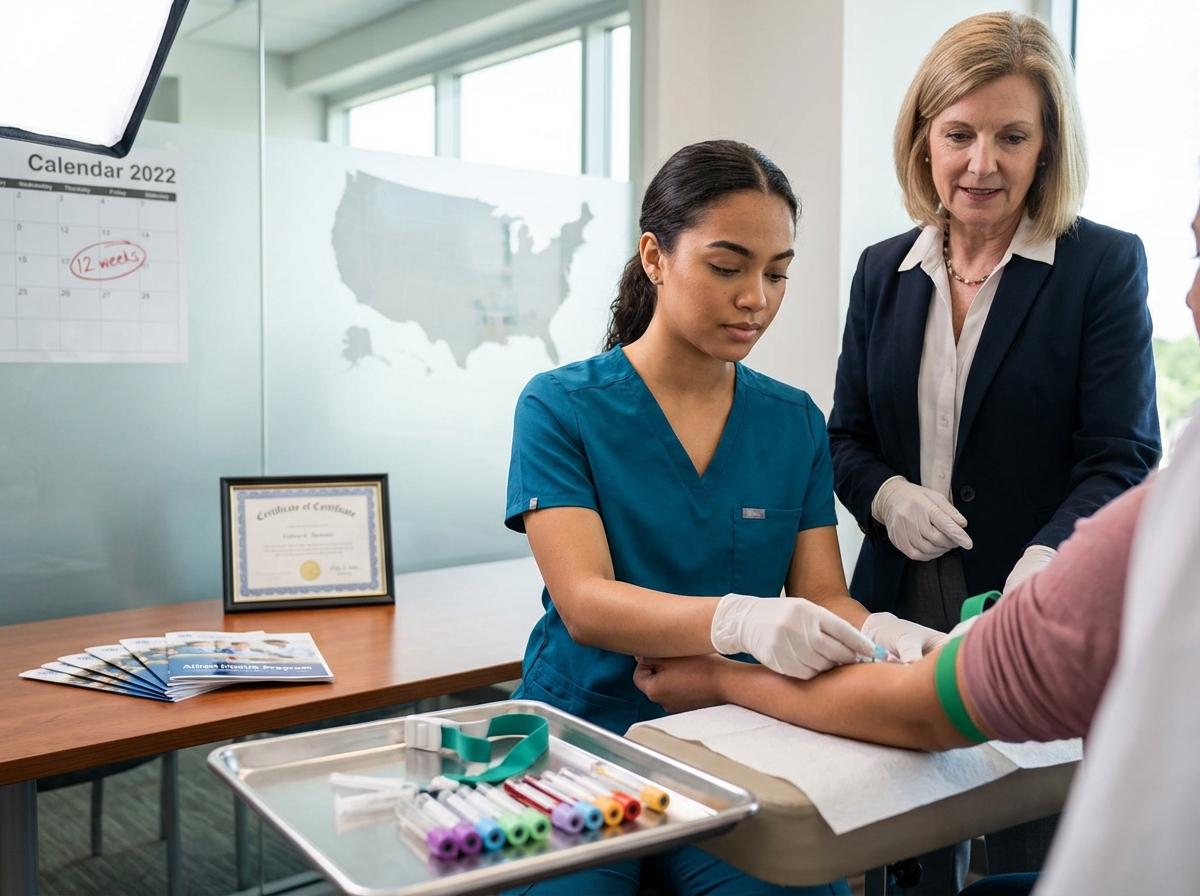
Clinical requirements are the most critical part of any fast track program. Hands on skill acquisition is usually scheduled toward the end of the course. Most national certification bodies have strict rules about the number of draws a student must perform. The National Healthcareer Association (NHA) requires 30 successful venipunctures. It also requires 10 capillary sticks on live subjects. Some programs like TCAT Murfreesboro set the bar higher at 40 successful draws. Clinical rotations often take place in hospitals or outpatient labs. During these hours, students work under the supervision of an experienced technician. This is where they learn the nuances of the job, such as finding difficult veins or working with elderly patients.
The labor market for phlebotomists remains strong. Data from the Bureau of Labor Statistics projects a growth rate of 8 percent for this field through 2032, which is faster than the average for all occupations. The median annual wage is approximately $41,810. In high demand areas like New York or California, wages can be significantly higher. Common employers include large hospital systems and private diagnostic laboratories like Quest or Labcorp. Clinics and urgent care centers also hire many phlebotomists. Blood donation centers are another major employer. These facilities need technicians to collect life saving blood products from donors. Many students find employment within a few weeks of receiving their certification results, particularly if they treat their clinical rotations as a working interview.
Phlebotomy often acts as a gateway to other allied health careers. It is a common entry point for those who eventually want to become medical laboratory technicians. The experience gained in the lab is also helpful for those pursuing radiology technology or respiratory therapy. Some phlebotomists move into roles as physical therapy or occupational therapy assistants. Furthermore, phlebotomy experience is highly valued for applications to nursing, PA, or medical school, as these programs often require patient contact hours for admission. Because fast track programs are so short, they allow workers to enter the field and then use employer tuition reimbursement to pay for further education. This makes phlebotomy a strategic first step in a long term healthcare career.
When comparing programs, readers should track specific metrics to ensure they are getting a quality education. Program length and tuition are the most obvious factors. However, clinical hours are just as important. A program with more clinical hours usually leads to better job readiness. Students should also look at the certification pass rate. This shows how well the school prepares its graduates for national exams. Job placement rates are another vital metric. Schools with strong partnerships with local hospitals often have higher placement rates. The 10 Cheapest Phlebotomy Classes & Training Programs – Stepful list can help students find affordable options that still meet these high standards.
Typical schedules for these programs show the intense pacing required. An 8 week intensive might look like this.
| Weeks | Focus Area | Daily Activities |
|---|---|---|
| Weeks 1-3 | Theory and Safety | Classroom lectures on anatomy and infection control. |
| Weeks 4-5 | In-Class Lab | Practicing draws on synthetic arms and classmates. |
| Weeks 6-8 | Clinical Rotation | Full time hours at a local hospital or clinic. |
A 12 week part time program follows a different rhythm. This is common at schools like the Phlebotomy Technician Certificate – Carroll Community College.
| Weeks | Focus Area | Schedule |
|---|---|---|
| Weeks 1-6 | Core Knowledge | Evening classes twice a week covering lab operations. |
| Weeks 7-10 | Skill Development | Weekend lab sessions for venipuncture practice. |
| Weeks 11-12 | Externship | Supervised clinical hours at a partner facility. |
These schedules show that while the programs are short, they require a significant commitment. Students must be prepared to study hard and practice their technical skills daily. The reward is a fast path into a stable and growing profession.
Choosing the Best Fast-Track Program
Choosing a phlebotomy program that lasts less than three months requires a careful look at the details. You want a path that is fast but also respected by hospitals and labs. The first step is understanding how schools are approved. Programmatic accreditation from the National Accrediting Agency for Clinical Laboratory Sciences (NAACLS) is the top tier for lab education. While many short programs do not have this specific label, they should still have institutional accreditation. This means a recognized agency oversees the entire school.
You must also check for state regulatory approval. While most states do not require a separate license, four specific states have strict regulations: California, Louisiana, Nevada, and Washington. In these states, you cannot work without a state-issued license or registration that requires a specific number of training hours. For instance, KPSAHS in California specifically targets the state’s CPT I license requirements. If a program is not state approved, your certificate might be useless in those regions.
Accreditation directly impacts your ability to sit for national exams. Most employers look for certifications from the National Healthcareer Association (NHA), the American Society for Clinical Pathology (ASCP), or the National Center for Competency Testing (NCCT). For example, the U.S. Career Institute prepares students specifically for the NHA Certified Phlebotomy Technician exam. If a school lacks proper standing, these certifying bodies may reject your application. This would leave you with a certificate but no way to prove your skills to a hiring manager.
Admissions and Readiness Requirements
Most fast-track programs have straightforward entry rules. You generally need a high school diploma or a GED. Some schools like the U.S. Career Institute allow students to start as young as 16, though employment usually requires being 18. You should prepare for a list of health clearances before you begin any hands-on work. This includes proof of immunizations for Hepatitis B, measles, mumps, and rubella. You will likely need a recent tuberculosis test and a flu shot.
The enrollment process moves quickly in accelerated programs. You should have your background check and drug screen completed early. Many clinical sites require these before they allow you on the floor. You should also look for a CPR certification course. Being certified in Basic Life Support (BLS) is often a prerequisite for starting an externship. If you choose an intensive schedule, be ready for a heavy time commitment. Programs like the one at TCAT Murfreesboro run three days a week for several hours. You must balance the classroom time with the hours needed for lab practice.
Clinical Competency Benchmarks
A legitimate program must prove you can actually draw blood. Online programs are only legitimate if they include a verified hands-on clinical component; you cannot learn the physical skill of venipuncture through a screen alone. You should look for specific numbers regarding venipunctures and capillary sticks. The NHA requires a minimum of 30 successful venipunctures and 10 capillary sticks on live subjects. Some schools set the bar higher. TCAT Murfreesboro requires 40 successful draws. If a program only uses synthetic arms, it is not providing enough experience.
High quality programs use competency checklists. These lists track your ability to identify patients, select the correct tubes, and follow safety protocols. You should expect a mix of classroom theory and clinical rotations. For instance, KPSAHS offers an 8 week program that includes 160 hours of clinical rotation. This ensures you have seen a variety of patient types and situations before you start your first job.
Cost Ranges and Financing Options
Tuition for these programs varies based on the school type and location. Online options are often the most affordable. The U.S. Career Institute costs about $979 when paid in full. Community college certificates like the one at Carroll Community College can cost $2,425 or more. You must also factor in extra fees for scrubs, textbooks, and lab supplies. Some programs include the cost of the national exam voucher in the tuition, which saves you about $120 to $160.
Financing is available even for short courses. Many schools offer interest free payment plans. Since these are often non-credit workforce programs, they typically do not qualify for federal Pell Grants. However, you should check with your local American Job Center to see if you qualify for WIOA grants or other workforce training funds that cover tuition for high-demand healthcare roles. Some hospitals offer tuition reimbursement if you agree to work for them after graduation. While low cost programs are tempting, you must ensure they provide the clinical hours you need. A cheap program that does not help you find an externship might end up costing you more in the long run.
Comparing School Outcome Metrics
You should demand data on how well students do after they finish. Graduation rates tell you if the school supports its students through the finish line. Certification pass rates are even more important. If a high percentage of students fail the NHA or ASCP exams, the curriculum is likely weak. You should also ask about job placement rates within six months of completion.
Strong schools often have partnerships with local healthcare systems. Cambridge Health emphasizes hands-on training and certification prep to help with these outcomes. Look for schools that offer career services like resume help and interview coaching. These support systems are vital when you are trying to break into the field quickly.
Decision Checklist and Questions for Admissions
Use this list to compare your options before signing any contracts.
Essential Questions to Ask
Does the program meet the requirements for the ASCP or NHA exams?
How many live blood draws will I complete during the course?
Does the school provide a clinical externship site or must I find my own?
What is the exact pass rate for the national certification exam over the last year?
What is the refund policy if I need to withdraw after the first week?
Are there any hidden fees for lab kits or insurance?
Who supervises the clinical rotations and how is my performance graded?
| Program Name | Duration | Tuition Estimate | Key Feature |
|---|---|---|---|
| U.S. Career Institute | 3 months | ~$979 | Self paced online with lab kit |
| Carroll Community College | 3 months | ~$2,425 | Evening classes and clinicals |
| AIMS Education | 1 to 3 months | ~$1,300 | Fastest completion options |
| KPSAHS | 8 weeks | Under $5,500 | Extensive clinical hours |
Readiness Checklist
Confirm you have your high school diploma or GED ready for upload.
Check your immunization records and schedule any missing boosters.
Budget for the national exam fee if it is not included in tuition.
Verify if your state requires a separate license beyond national certification.
Set aside at least 10 to 15 hours a week for study and lab practice.
Final Recommendations and Next Steps
Choosing a program requires looking at more than just the speed of completion. You need to ensure the school has proper accreditation or state approval. This is the only way to guarantee your education counts toward national certification. Documented clinical experience is another non negotiable item. Most certifying bodies like the NHA require at least 30 successful venipunctures and 10 capillary sticks. If a program does not provide a way to get these draws, you will struggle to get your credentials. Employment outcomes are also important. Look for schools that share their job placement rates or have partnerships with local hospitals.
The 10 Week Action Plan
Week 1. Research programs and confirm state licensing rules. If you live in California, Louisiana, Nevada, or Washington, your rules are stricter than in other places.
Week 2. Submit applications and order your high school transcripts. Most programs require a diploma or GED.
Week 3. Gather medical records and get your immunizations. You will need proof of Hepatitis B shots and a recent TB test.
Week 4. Complete a CPR certification course. You must choose a Basic Life Support (BLS) for Healthcare Providers course.
Week 5. Start your didactic coursework. Focus on anatomy. Physiology is also a core subject.
Week 6. Begin your lab practice. This is when you perform your first blood draws on practice arms or volunteers.
Week 7. Secure your externship placement. Some schools like Salt Lake Community College help find sites. Others require you to find your own.
Week 8. Complete your required clinical hours. Ensure every successful draw is logged and signed by a supervisor.
Week 9. Use practice exams from the NHA or ASCP. Review safety protocols. Quality control is another focus.
Week 10. Schedule and pass your national certification exam. Many students use the Online Phlebotomy Technician Program | Self-Paced Course to prepare for the CPT exam.
Trusted Resources for Verification
Always verify program claims before paying tuition. The American Society for Clinical Pathology (ASCP) is the gold standard for certification. The National Healthcareer Association (NHA) is another widely recognized body. You can check the National Accrediting Agency for Clinical Laboratory Sciences (NAACLS) website for a list of accredited programs. For salary and job growth data, visit the Bureau of Labor Statistics (BLS) Occupational Outlook Handbook. Your state health department website will list specific licensing requirements if they exist in your area. Organizations like the National Center for Competency Testing (NCCT) also provide eligibility paths for graduates of fast track programs.
Final Steps for Enrollment
You are now ready to take the final step toward your new role. Use the checklist below to compare your top three program choices. Verify that each one allows you to sit for a national exam. Check that the clinical component is documented. Do not enroll until you have confirmed the total cost and the refund policy. Taking these steps now will save you time and money later.
Checklist for Program Comparison
- Confirmed state health department approval.
- Verified national certification exam eligibility (ASCP or NHA).
- Documented clinical hours and draw requirements.
- Total cost including immunizations and CPR.
- Recent job placement data for graduates.
Moving Forward
The demand for phlebotomists is high. Hospitals and clinics need skilled technicians who can work accurately under pressure. By choosing a fast track program that meets these standards, you can enter the workforce in just a few months. Use the resources provided to double check every claim. Your career in allied health starts with a solid educational foundation. Verify your chosen school today and begin your 10 week roadmap to certification.
References
- Online Phlebotomy Technician Program | Self-Paced Course — Our self-paced, online Phlebotomy Technician Certificate Program will prepare you for certification (CPT), and a role as a Phlebotomist in as little as 3 months …
- Phlebotomy Technician Certificate – Carroll Community College — Fast & Affordable: Get job-ready skills in just 3 months, without going into debt. Real-World Experience: Get hands-on training in blood collection, processing, …
- Phlebotomy (Cert) — Earn your phlebotomy certificate in 8 weeks. Get hands-on training and a great start in health care. Apply Now Contact Phlebotomy …
- 10 Cheapest Phlebotomy Classes & Training Programs – Stepful — AIMS Education · Cost: $1,300 · Location: Piscataway, NJ · Type of program: Community College · Time to complete: 1 month or 3 months · Resulting certificate: NHA – …
- Online Phlebotomy Class & National Certification — The curriculum can be completed in as little as 4 weeks, but you will have as long as 6 months to complete the course from the time of enrollment. Upon …
- Phlebotomy Technician Program at Cambridge Health — 3 Month* Phlebotomy Technician Training Program. If you're a compassionate, detail-oriented person interested in a rewarding career as part of a healthcare …
- Certificate in Phlebotomy Technician – South College — The 3-month Certificate in Phlebotomy Technician program at South College is designed to prepare you with basic knowledge and skills in collecting blood and …
- Phlebotomy Technician | Career Training Solutions, LLC — Train to become a Certified Phlebotomy Technician in as little as 3 months! As a Phlebotomy Technician, you will be trained to draw blood samples from patients.
- Workforce & Skills – Certified Phlebotomy Technician — Certificate. Program length is 3 months. Schedule: Mon, Tue, Wed – 8:00 am to 12:00 noon. Course Information document located under Books and Supplies Lists.
- Phlebotomy Technician Certification Program | Blue Ridge CTC — The 4-month, fast-paced Phlebotomy Technician certification offers students hands-on training to develop occupational proficiency in collecting blood specimens …
Legal Disclaimers & Brand Notices
The content provided in this article is for informational purposes only and does not constitute medical advice, diagnosis, or treatment. Always seek the advice of a qualified healthcare professional or medical educator regarding clinical procedures, risks, or medical training requirements.
All product names, logos, and brands mentioned in this text are the property of their respective owners. All company, product, and service names used in this article are for identification purposes only. Use of these names, logos, and brands does not imply endorsement.