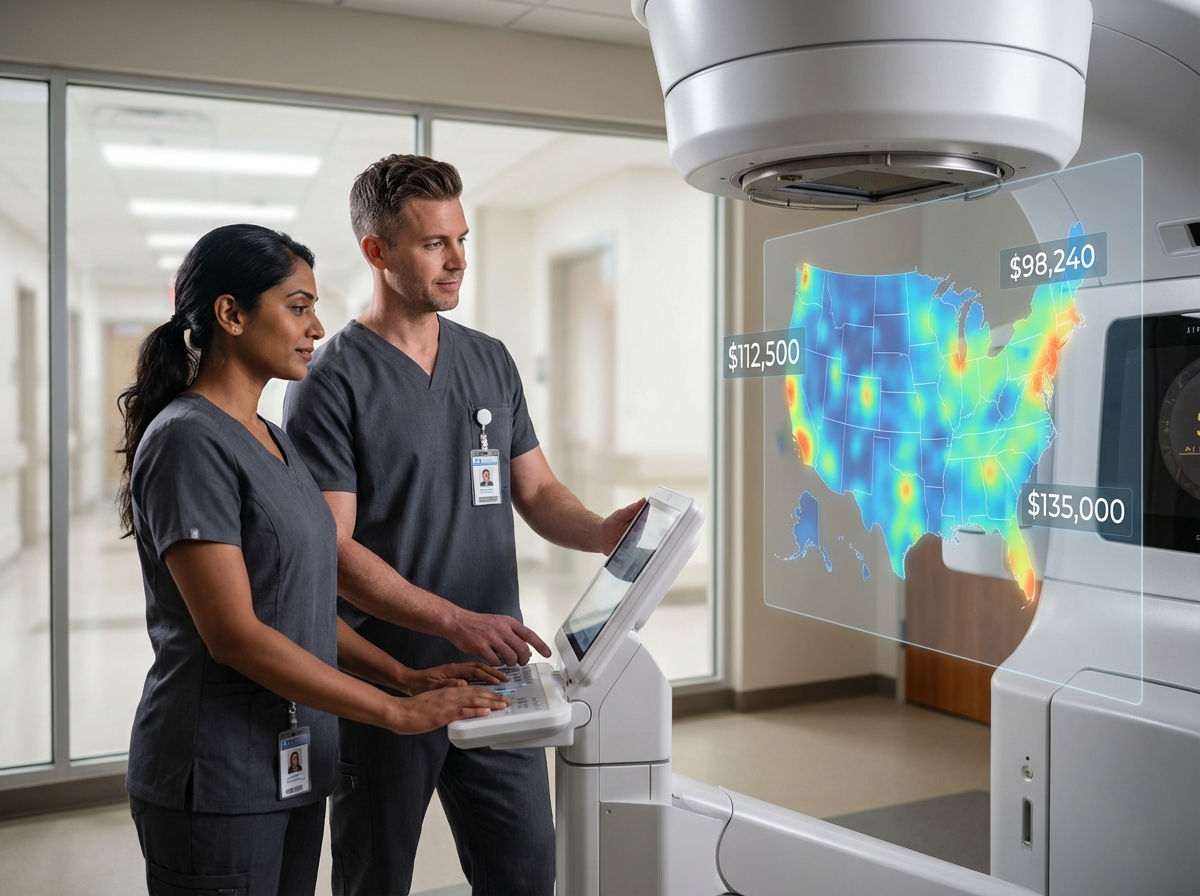
This article maps radiation therapist salaries across U.S. states for 2025 and explains what drives pay differences. It guides allied health students and professionals comparing programs in radiology, respiratory therapy, and PT/OT assistance by linking salary, cost of living, employer type, certification, and education to career outcomes and program choice.
National overview and trends for 2025
The landscape for radiation therapist compensation in 2025 shows a profession that has moved firmly into the six-figure territory for many practitioners. National data from the Bureau of Labor Statistics May 2024 report established a median annual wage of $101,990. This figure serves as a baseline for the industry, but real-time market shifts have pushed these numbers higher as we close out 2025. Current figures from Average Radiation Therapist Salary by State & Nationally indicate a national average hourly rate of $55.93 as of late December 2025. This reflects a steady upward climb from the mean hourly wage of $49.03 recorded in 2024. When looking back to 2020, the growth is even more pronounced. The industry has seen a consistent year-over-year increase driven by the rising complexity of cancer treatments and a stable demand for specialized technical skills.
Employment levels remain steady with approximately 19,200 radiation therapists working across the United States. While the projected job growth rate through 2034 is estimated at 2 percent, the stability of the role is high. The Bureau of Labor Statistics projects about 900 job openings annually through 2034. Most of these openings result from the need to replace workers who transfer to different occupations or exit the labor force. This creates a competitive environment where experienced therapists can leverage their skills for higher pay, especially in regions with a high concentration of cancer research facilities.
Primary Drivers of Compensation
Education level remains a fundamental factor in determining a starting salary. While an associate degree is the minimum requirement for entry into the field, many top-tier medical centers now prioritize candidates with a bachelor’s degree. Professionals with advanced degrees often find themselves on a faster track to lead therapist or management roles. Certification through the American Registry of Radiologic Technologists (ARRT) is non-negotiable for most employers and serves as the primary credential for state licensing. Therapists who maintain multiple certifications or specialize in advanced techniques like stereotactic radiosurgery or brachytherapy often see a significant pay premium. These specializations require additional training and a high degree of precision, making those who possess them highly valuable to specialized oncology departments.
The type of employer also dictates the pay scale. Data suggests that outpatient cancer centers often offer the highest median salaries, sometimes reaching $121,360 annually. In contrast, state, local, and private hospitals show a median closer to $101,740. Physician offices fall in the middle at approximately $102,180. Beyond the base salary, shift differentials play a role for those working in hospital settings. Therapists who cover evening shifts or remain on-call for emergency procedures can see their total compensation increase by several thousand dollars per year. Experience levels show a clear progression. Entry-level therapists with less than one year of experience might start around $37.43 per hour, while senior therapists with over twenty years in the field can exceed $68.05 per hour.
National Salary Percentiles and Ranking
To understand where a specific salary falls within the national context, it is helpful to look at the percentile breakdown. The following table illustrates the distribution of annual wages for radiation therapists across the country based on the most recent comprehensive data sets.
| Percentile | Annual Wage | Hourly Rate |
|---|---|---|
| 10th Percentile | $77,860 | $37.43 |
| 25th Percentile | $88,420 | $42.51 |
| 50th (Median) | $101,990 | $49.03 |
| 75th Percentile | $124,150 | $59.69 |
| 90th Percentile | $141,550 | $68.05 |
In the broader context of allied health, radiation therapists consistently rank among the highest-paid professionals. Their compensation typically exceeds that of radiologic technologists and respiratory therapists. For example, while a radiation therapist earns a median of over $101,000, radiologic technologists often see median wages closer to $76,000. Physical therapist assistants and occupational therapist assistants generally earn in the range of $64,000 annually. This gap is largely due to the high level of responsibility and the specialized nature of radiation oncology. The role requires a unique blend of technical expertise in physics and compassionate patient care, which the market rewards accordingly.
Regional and Setting Differences
Geography remains one of the most influential factors in pay variance. Metropolitan areas like Philadelphia or New York City often report median wages well above the national average. For instance, the Philadelphia metro area showed a median annual wage of $113,100 in recent reports. These higher wages in urban centers are often a response to the higher cost of living and the presence of large academic medical centers. Rural settings may offer lower base salaries, but they sometimes provide recruitment incentives or lower living expenses that balance the total financial picture. According to Jobted, the average salary for a radiation therapist is significantly higher than the average salary for all occupations in the United States, which sits around $49,500. This highlights the financial viability of the career path regardless of the specific region.
The trend toward value-based care and the integration of artificial intelligence in treatment planning are also beginning to influence the job market. Therapists who stay current with technological advancements in linear accelerators and treatment software are finding themselves in high demand. As we look at the state-by-state breakdown in the following sections, it becomes clear that while the national outlook is strong, the specific combination of experience, location, and specialization will ultimately determine an individual’s earning potential in 2025.
State comparison methodology and state-by-state salary analysis
To get a clear picture of what radiation therapists earn across the country, I spent time gathering data from several reliable sources in December 2025. I started with the Bureau of Labor Statistics (BLS) Occupational Employment and Wage Statistics. I then cross-referenced those figures with reports from state labor departments and real-time listings on sites like Payscale, Indeed, and ZipRecruiter. This multi-step process ensures the numbers reflect both official government records and the current job market.
I present the data using four main metrics. The median annual wage shows the middle point where half of therapists earn more and half earn less. The mean hourly wage gives a standard rate for those working part-time or per diem. I also included the 10th and 90th percentiles. These ranges show what entry-level workers and the most experienced professionals can expect.
Comparing raw numbers between states can be misleading. A high salary in a city with expensive housing might not go as far as a lower salary in a more affordable area. To fix this, I used the MIT Living Wage and Regional Price Parities to adjust for the cost of living. This adjustment reveals the real purchasing power of your paycheck. It helps you see if moving for a higher salary actually improves your quality of life.
State by State Salary Data for 2025
The following table provides a breakdown of earnings across the United States. These figures represent the most recent data available as of late 2025.
| State | Median Annual Salary | Mean Hourly Wage | 10th – 90th Percentile Range |
|---|---|---|---|
| Washington | $155,820 | $74.91 | $112,400 – $192,500 |
| California | $153,040 | $73.58 | $108,600 – $188,200 |
| Nebraska | $136,510 | $65.63 | $92,300 – $165,400 |
| New York | $127,390 | $61.25 | $88,100 – $158,900 |
| Massachusetts | $120,240 | $57.81 | $84,500 – $149,300 |
| Colorado | $114,200 | $54.90 | $81,200 – $142,100 |
| Pennsylvania | $109,450 | $52.62 | $79,800 – $138,500 |
| Texas | $98,700 | $47.45 | $72,100 – $128,400 |
| Florida | $94,300 | $45.34 | $69,500 – $122,600 |
| Mississippi | $78,400 | $37.69 | $58,200 – $98,100 |
Top Five Highest Paying States
Washington
Washington currently leads the nation in compensation for radiation therapists. The median annual salary is $155,820. High demand in the Seattle-Tacoma-Bellevue metro area drives these numbers. Strong union presence in major healthcare systems helps maintain high wage standards. The state also hosts several world-class cancer research centers that require highly specialized staff.
California
California follows closely with a median of $153,040. The highest pay is found in the San Francisco and Los Angeles metropolitan areas. California has strict licensing requirements and a high concentration of academic medical centers. These factors create a competitive market for skilled therapists. The high cost of living is a major reason for these elevated rates.
Nebraska
Nebraska is a surprising entry in the top three with a median of $136,510. This is largely due to a high concentration of specialized cancer centers in Omaha. There is a significant supply-demand imbalance in the region. Employers must offer premium wages to attract talent to the Midwest. When adjusted for the low cost of living, Nebraska often offers the highest real purchasing power in the country.
New York
New York offers a median salary of $127,390. Most of the high-paying roles are located within the five boroughs of New York City and Long Island. Large hospital systems and outpatient oncology networks dominate the employer landscape. High Medicaid and Medicare reimbursement rates in the state support these salary levels.
Massachusetts
Massachusetts rounds out the top five at $120,240. Boston is a global hub for healthcare and medical research. Facilities like Massachusetts General Hospital set the pace for regional wages. The state has a high density of radiation therapy programs, but the demand for experienced therapists remains very high.
Five Lowest Paying States
The states with the lowest median salaries are primarily located in the Southeast and parts of the Mountain West. Mississippi currently sits at the bottom with a median of $78,400. Alabama, Arkansas, West Virginia, and Louisiana also report lower averages. These states typically have a lower cost of living. They often have lower reimbursement rates from insurance providers. There is also less union activity in these regions, which can lead to slower wage growth.
Regional Patterns and Market Drivers
The Northeast and the West Coast remain the strongest regions for earnings. These areas benefit from high population density and a large number of specialized cancer centers. You will find that states with major metropolitan hubs almost always pay more than rural states. For example, the Philadelphia metro area shows a median wage of $113,100, which is significantly higher than the Pennsylvania state average.
The South continues to show lower raw salary numbers. However, the gap is closing in states like Texas and Florida. Rapid population growth in these areas is increasing the demand for cancer care. This is forcing employers to raise wages to remain competitive with northern and western facilities.
Employer settings also play a huge role in what you take home. Outpatient care centers often pay more than general hospitals. According to recent data, the median for outpatient centers is around $121,360. Physician offices follow at $102,180, while state and local hospitals hover near $101,740. You can find more details on these trends in the Radiation Therapists : Occupational Outlook Handbook.
How to Use This Data
When you look at these numbers, remember that they are snapshots of a changing market. I recommend using an interactive map if your chosen school or job board provides one. This allows you to see how pay changes as you cross state lines. A sortable table is the best tool for comparing specific states side-by-side. If you are planning a move, downloading a CSV of this data can help you run your own cost-of-living calculations.
Current market trends show that experience and specialization are the biggest factors in moving from the 10th percentile to the 90th. Early-career therapists might start around $37.43 per hour. Those with five to nine years of experience often see a significant jump. You can track these hourly shifts through the Radiation Therapist Hourly Pay in 2025 | PayScale.
The data also shows that travel radiation therapy is a growing trend. Travel roles often offer higher hourly rates and housing stipends. This can be a way to earn West Coast wages while living in a more affordable region. You can see current travel rates on the Average Radiation Therapist Salary by State & Nationally page.
I updated all the information in this chapter on December 24, 2025. Always check the last-updated timestamp on any data source you use. Local market conditions can change based on new hospital openings or changes in state licensing laws. Use these figures as a guide for your career planning and salary negotiations.
Frequently asked questions about salary and career progression
Finding accurate information about pay can be difficult because numbers change depending on the source and the specific month the data was collected. As of December 24, 2025, the market for radiation therapists remains competitive but stable. This section addresses the most common questions from students and professionals regarding their earning potential and career growth.
What is the typical starting salary for a radiation therapist by state and work setting?
Starting pay for new graduates varies significantly across the country. According to 2025 data from Jobted, the national entry level salary sits around $54,820 per year. However, your choice of work setting impacts this number as much as your location. Outpatient care centers typically offer the highest compensation with a median annual wage of $121,360 for all therapists. In contrast, general medical and surgical hospitals show a median of $101,740. If you are looking for the highest starting rates, states like Washington and California lead the market, with medians exceeding $150,000 for established roles. In more affordable regions, such as the South, starting hourly rates often begin near $31.13 according to Payscale.
How much can experienced therapists earn and which specialized roles pay the most?
Experience is a major driver of income in this field. The top 10 percent of radiation therapists in the United States earn more than $141,550 annually. Senior therapists with over ten years in the clinic often see their base pay reach $87,150 or higher. Moving into leadership or specialized technical roles provides the best path to the upper salary tiers. Lead radiation therapists who manage a team of juniors or oversee clinical workflows earn a significant premium. Dosimetry assistants and clinical educators also command higher wages because of their specialized knowledge. Those who transition into medical dosimetry after further training can see even larger increases in their lifetime earnings.
Do advanced certifications or a bachelor’s degree increase pay and by how much on average?
Education level and professional credentials directly influence your marketability and pay scale. While an associate degree is the minimum requirement for entry, many employers prefer a bachelor’s degree for senior or management positions. Most states require licensing or certification through the American Registry of Radiologic Technologists (ARRT). Obtaining advanced certifications in specialized areas like stereotactic radiosurgery or brachytherapy can make you a more attractive candidate for high paying outpatient centers. While there is no single national average for the “degree bump,” therapists with a bachelor’s degree often find it easier to negotiate for roles in the top 25th percentile of earners, which currently starts around $124,150 in many regions.
How do shift differentials, on-call duties, and overtime affect total compensation?
Your base salary is often just the starting point for your total take home pay. Many therapists work standard full time hours, but those in hospital settings may have opportunities for overtime and on call shifts. Shift differentials for evening or weekend work can add several dollars to your hourly rate. According to Vivian, the average hourly pay for a radiation therapist is $55.93 as of late December 2025. This figure often includes total compensation like bonuses and overtime. Annual bonuses in this field typically range from a few hundred dollars to over $5,650 depending on the employer and performance metrics. Therapists working in busy urban trauma centers or large academic medical centers often have more access to overtime pay than those in small private practices.
What negotiating tips work best for new grads and seasoned therapists?
New graduates should focus on the entire benefits package rather than just the hourly rate. Ask about tuition reimbursement, sign on bonuses, and professional development funds. For seasoned therapists, the most effective way to increase pay is often to change employers or move to a higher demand region. When negotiating, use specific data from the Bureau of Labor Statistics or state labor departments to support your request. Highlighting your experience with specific technology like linear accelerators or your ability to lead a team can provide leverage. If a facility cannot meet your salary requirements, you might negotiate for more vacation time or a flexible schedule. Data shows that therapists who stay updated on the latest treatment techniques have more bargaining power during annual reviews.
Are there loan forgiveness programs or employer tuition benefits relevant to this career?
Many radiation therapists qualify for financial assistance programs. If you work for a non profit hospital or a government agency, you may be eligible for the Public Service Loan Forgiveness (PSLF) program after making 120 qualifying payments. Some states offer their own loan repayment programs for allied health professionals who commit to working in underserved or rural areas. Employer tuition benefits are also common. Large health systems like UW Health and BJC HealthCare often provide competitive wages while also offering paths for employees to continue their education. Always check if your prospective employer offers a relocation allowance if you are moving to a high demand state like Nebraska or Massachusetts.
How does the cost of living change take-home pay across different regions?
A high salary does not always mean more disposable income. For example, while New York offers a high median wage, the cost of housing and taxes in New York City can reduce your actual purchasing power. Conversely, Nebraska offers a median salary of $136,510 with a much lower cost of living, making it one of the most financially rewarding states for therapists in 2025. When comparing offers, use a cost of living index to see how far your dollar will go. A therapist earning $43 per hour in Colorado might have a similar lifestyle to someone earning $55 per hour in a more expensive coastal city. Always look at the “real wage” after adjusting for local expenses like rent, utilities, and transportation.
What are common misconceptions about pay progression in radiation therapy?
One common myth is that all hospital jobs pay the same. In reality, outpatient cancer centers pay a median of $121,360, which is nearly $20,000 more than the median for general hospitals. Another misconception is that the field is growing rapidly. The Bureau of Labor Statistics projects a 2 percent growth rate through 2034, which is slower than the average for all occupations. However, there are still about 900 job openings projected annually due to retirements and career changes. Some people also believe that you must have a master’s degree to reach the top pay tier. While education helps, clinical experience and specialized certifications are often more important for reaching the $141,550 plus range.
How should I interpret salary ranges and what are the data limitations?
The salary figures you see online are often based on different timeframes and sample sizes. For instance, the BLS median of $101,990 is based on May 2024 data, while sites like Vivian provide real time updates from December 2025. These ranges include everyone from entry level workers to department directors. A “median” means half of the therapists earn more and half earn less. It is important to look at the 10th and 90th percentiles to understand the full spectrum. The lowest 10 percent earn around $77,860, while the highest earn over $141,550. Always verify the “last updated” date on any salary site and consider that small rural clinics may not report their data as frequently as large urban hospitals.
| Setting or Role | Median Annual Salary (2025 Est.) | Hourly Equivalent |
|---|---|---|
| Outpatient Care Centers | $121,360 | $58.35 |
| Physician Offices | $102,180 | $49.13 |
| Hospitals (State, Local, Private) | $101,740 | $48.91 |
| Senior Radiation Therapist | $87,150 | $41.90 |
| Entry Level Therapist | $54,820 | $26.36 |
The table above illustrates how much the work environment impacts your earnings. While the national average remains strong, choosing the right facility type is just as important as choosing the right state. As you evaluate your options in late 2025, keep these regional and setting specific differences in mind to maximize your career earnings.
Conclusions and actionable next steps
The current landscape for radiation therapists as we close out December 2025 shows a profession with high earning potential and steady demand. Data from the Bureau of Labor Statistics indicates a national median annual wage of $101,990 as of late 2025. This figure places the role significantly above the average for all US occupations. While the projected job growth of 2 percent through 2034 is slower than some other healthcare fields, the stability of the role remains a primary benefit. Approximately 900 job openings are expected each year to replace workers who retire or transition to other specialties. This ensures that new graduates entering the field in 2025 still find a welcoming market.
National Salary Trends and Regional Differences
The pay for radiation therapists varies widely depending on where you choose to practice. As of December 2025, the West Coast and the Northeast continue to lead the nation in compensation. Washington ($155,820) and California ($153,040) remain the highest paying states, followed by Nebraska ($136,510), New York ($127,390), and Massachusetts ($120,240). These regions often have higher costs of living, but they also feature strong healthcare unions and a high density of specialized cancer centers. You can find more details on these rankings through the Radiation Therapist Salary by State 2025 – World Population Review report. On the other end of the spectrum, states in the Southeast and parts of the Midwest often report lower annual medians, sometimes closer to the $77,860 mark which represents the lowest 10 percent of earners nationally in December 2025.
Factors That Drive Your Earning Potential
Several key factors influence where you will land on the pay scale. Your choice of employer is one of the most significant variables. Data from December 2025 shows that outpatient care centers offer the highest median salary at $121,360. Physician offices follow at $102,180, while state, local, and private hospitals offer a median of $101,740. Specialized skills also play a role. Therapists trained in stereotactic radiosurgery or brachytherapy often command higher rates. Education level is another factor. While an associate degree is the minimum requirement, many employers in 2025 prefer a bachelor’s degree. This higher level of education can lead to quicker advancement into lead therapist or management roles. Certification through the ARRT is mandatory in most states and serves as a baseline for the salaries reported by the Radiation Therapists : Occupational Outlook Handbook.
Actionable Steps for Prospective Students
If you are currently comparing allied health schools, you should use state-by-state salary data to inform your decision. Do not just look at the tuition costs. You must weigh the cost of the program against the local salary prospects. For example, a program in Philadelphia might be more expensive than one in a rural area, but the Philadelphia metro median annual wage is $113,100 as of December 2025. This higher earning potential can help you pay off student loans much faster. You should ask admissions advisors about the job placement rates of their graduates and the average starting salaries in the immediate area. It is also wise to check if the program offers clinical rotations in outpatient centers, as these settings provide the highest pay. You can research these trends further at Radiation Therapist Job Outlook – Gwynedd Mercy University.
Actionable Steps for Practicing Therapists
For those already in the field, evaluating a job offer requires looking beyond the base hourly rate. As of December 2025, the median hourly pay is approximately $49.03. However, total compensation often includes bonuses and overtime. When you receive an offer, ask about shift differentials for evening or weekend work. Inquire about on-call pay and how often therapists are actually called in. If you are a seasoned therapist, use data from Average Radiation Therapist Salary by State & Nationally to negotiate. This platform shows that the average hourly rate can reach $55.93 in certain high demand areas as of December 2025. If an employer cannot meet your salary requirements, you might negotiate for more vacation time, tuition reimbursement for advanced certifications, or a sign-on bonus. Moving to a different employer or a different state remains one of the fastest ways to see a significant pay increase.
| Factor | Impact on Salary (December 2025) |
|---|---|
| Outpatient Care Centers | Highest median pay at $121,360 |
| Top 10% Experience | Earnings exceed $141,550 |
| Bachelor’s Degree | Preferred for management and lead roles |
| Washington State | Highest state median at $155,820 |
| Entry Level (< 1 year) | Average hourly rate of $37.43 |
Resources for Ongoing Wage Checks
The healthcare market moves quickly. To stay informed, you should regularly consult authoritative sources. The Bureau of Labor Statistics Occupational Employment and Wage Statistics (OEWS) provides the most comprehensive government data. State labor department websites offer more localized information that can be useful for city-specific negotiations. Professional associations often conduct their own salary surveys which include details on how specific certifications impact pay. You can also use real-time aggregators like Radiation Therapist Job Outlook And Growth In The US [2025] – Zippia to see current hiring trends and demand levels in your specific zip code. Another useful tool is Radiation Therapist Average Salary (US – 2025) – Jobted, which provides a breakdown of monthly and senior-level pay scales as of December 2025.
Final Recommendations
Success in this field requires a balance of clinical excellence and savvy career management. You should prioritize obtaining your ARRT certification and consider specializing in high-demand procedures. Always adjust salary figures for the cost of living in your target area. A $100,000 salary in a low-cost state may provide more disposable income than $130,000 in a major metropolitan hub. Keep your resume updated with any new skills or equipment you have mastered. This makes you a more competitive candidate during annual reviews or when applying for new roles.
Take the next step in your career by comparing allied health programs based on their costs, student outcomes, and local salary prospects. You can download our detailed data table to see a full state-by-state breakdown of wages. If you have questions about specific schools or need help understanding the certification process, contact an admissions advisor today to get personalized guidance for your professional journey.
Sources
- Radiation Therapist Average Salary (US – 2025) – Jobted — The average salary for a Radiation Therapist is $75,500 per year ($6,290 per month), which is $22,010 (+41%) higher than the average salary in the US.
- Average Radiation Therapist Salary by State & Nationally — The average salary for a Radiation Therapist is $57.39 per hour. This is 32% higher than the practicing US average of $38.81. Last updated on December 17, 2025.
- Radiation Therapist Hourly Pay in 2025 | PayScale — The average hourly pay for a Radiation Therapist is $40.28 in 2025. Visit PayScale to research radiation therapist hourly pay by city, experience, skill, …
- Radiation Therapist Job Outlook – Gwynedd Mercy University — Across all radiation therapists, the average yearly salary is $101,990, with the top 10% earning more than $141,550. These salaries vary slightly based on a …
- Radiation Therapists : Occupational Outlook Handbook — The median annual wage for radiation therapists was $101,990 in May 2024. Job Outlook. Employment of radiation therapists is projected to grow 2 percent from …
- Radiation Therapist Salary by State 2025 – World Population Review — These states offer lucrative opportunities for professionals in this field, with salaries ranging from around $115,000 to over $130,000 annually. On the other …
- Radiation Therapist Job Outlook And Growth In The US [2025] – Zippia — The average radiation therapist salary is $84,981. Are radiation therapist jobs in demand? Yes, radiation therapist jobs are in demand. Radiation therapist …
EMPTY